PR001A / PROPEL: Biomarker Goal And Interim Result
PR001 Low Dose (N=12)PR001 High Dose (N=12)
위 표에 aSyn, NFL, DATScan, MRI, MDS-UPDRS, cognition, ADL 본다고 하네!!Dementia (MoCA <14) 는 exclusion criteria 임!!!!Dose를 아직 모르네! (위의 NHP study 표의 safety margin으로도 잘 계산 안 되네)[Goal] 2020-12-23 Prevail Tx PR001 overview, p38(adult normal range: 1.1 - 8.1 μmol/L/d). (LLOQ; 0.56 μmol/L/d).
대상자
Goal
Pts with CSF gba activity below LLOQ at baseline
Increase to within 75% of normal range
Pts with CSF gba activity above LLOQ at baseline
>=30% increase over their baseline level
[RESULTS interim]One patient (GD1 (이면서 PD일것)):- increase in CSF GCase enzyme activity from an undetectable level at baseline to 3.0 μmol/L/d at month 3 following PR001 administration (1.4x10^14 vg)- approximately 3 months following PR001 administration, the patient experienced SAEs that are presumed to have been caused by an immune-mediated response to the AAV9 viral vector. The patient received additional immunosuppressive treatment and the SAEs have markedly resolved- Prevail has elected to modify the clinical protocol for the PROPEL trial in order to optimize the immunosuppression regimen, and has adapted the trial design to be open-label. The modifications have been endorsed by the independent data monitoring committee and discussed with and submitted to the FDA. PROPEL protocol amended to include sirolimus in addition to a shortened and reduced steroid regimen- Patient dosing has since resumed under the updated clinical protocol- Next BM & safety analysis on a subset of patients expected by mid-2021.
3. Change in GluCer levels in blood | Time Frame: Baseline and Months 1, 2, 3, 6, 9 and 124. Change in GluCer levels in CSF | Time Frame: Baseline and Months 3 and 125. Change in GluSph levels in blood | Time Frame: Baseline and Months 1, 2, 3, 6, 9 and 12 | GluSph (glucosylsphingosine)6. Change in GluSph levels in CSF | Time Frame: Baseline and Months 3 and 127. Immunogenicity of AAV9 and GCase in blood | Time Frame: Baseline and Day 14 and Months 1, 3, 6, 9 and 128. Immunogenicity of AAV9 and GCase in CSF | Time Frame: Baseline and Months 3 and 12
js: blood에서 GBA activity, GlcCer, GlcSph, Immunogenicity of AAV9 and GCase (NCT04127578) 에 GBA protein/mRNA 는 CSF의 Blood에 모두 없음
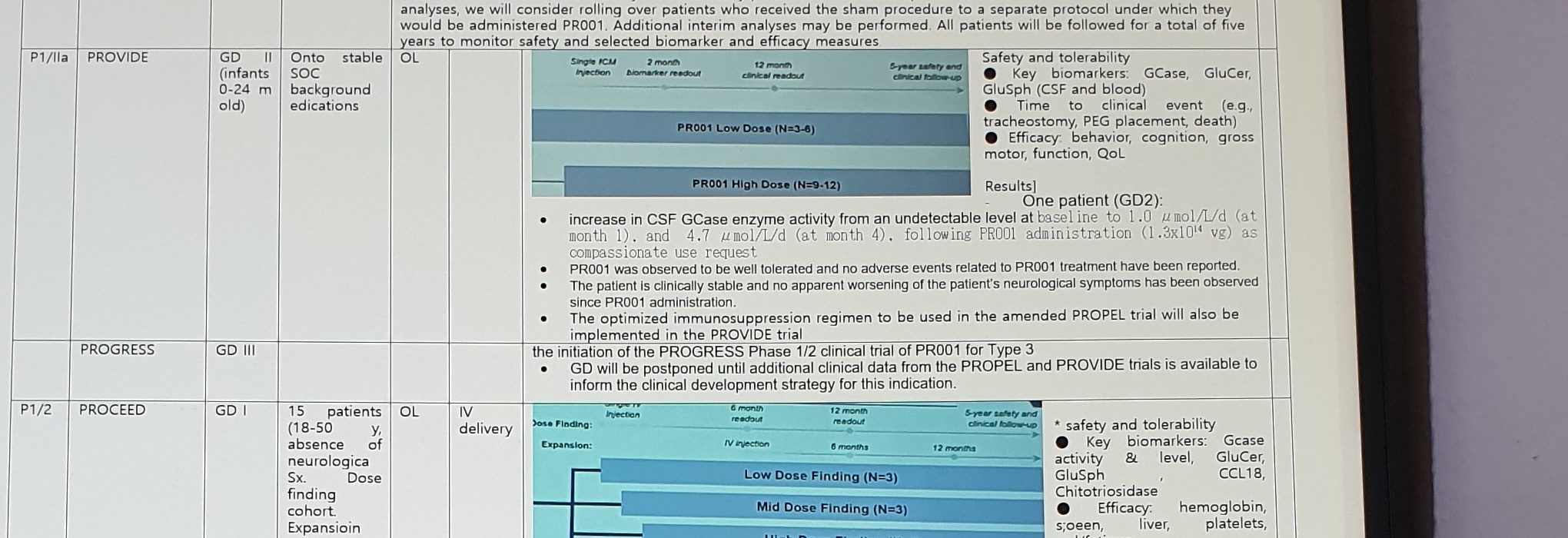
PR001A / PROVIDE
field
transcription
phase / name
P1/IIa; PROVIDE
target patient
GD II (infants 0-24 m old)
status / background
Onto stable SOC background medications
design
OL
route / timing
Single ICM injection; 2 month biomarker readout; 12 month clinical readout; 5-year safety and clinical follow-up
dose arms
PR001 Low Dose (N=3-6); PR001 High Dose (N=9-12)
primary / secondary visible outcomes
Safety and tolerability; Key biomarkers: GCase, GluCer, GluSph (CSF and blood); Time to clinical event (e.g., tracheostomy, PEG placement, death); Efficacy: behavior, cognition, gross motor, function, QoL
An unblinded interim analysis will be performed once all patients in the first cohort complete 12 months of treatment, and a second unblinded interim analysis will be performed once all patients in the second cohort complete 12 months of treatment. Provided that the safety and tolerability profile of PR001 is acceptable at the time of each of these interim analyses, we will consider rolling over patients who received the sham procedure to a separate protocol under which they would be administered PR001. Additional interim analyses may be performed. All patients will be followed for a total of five years to monitor safety and selected biomarker and efficacy measures
[Results]One patient (GD2):- increase in CSF GCase enzyme activity from an undetectable level at baseline to 1.0 μmol/L/d (at month 1), and 4.7 μmol/L/d (at month 4), following PR001 administration (1.3x10^14 vg) as compassionate use request- PR001 was observed to be well tolerated and no adverse events related to PR001 treatment have been reported.- The patient is clinically stable and no apparent worsening of the patient's neurological symptoms has been observed since PR001 administration.- The optimized immunosuppression regimen to be used in the amended PROPEL trial will also be implemented in the PROVIDE trial
PR001A / PROGRESS
field
transcription
name
PROGRESS
target patient
GD III
note
the initiation of the PROGRESS Phase 1/2 clinical trial of PR001 for Type 3 GD will be postponed until additional clinical data from the PROPEL and PROVIDE trials is available to inform the clinical development strategy for this indication.
PR001A / PROCEED
field
transcription
phase / name
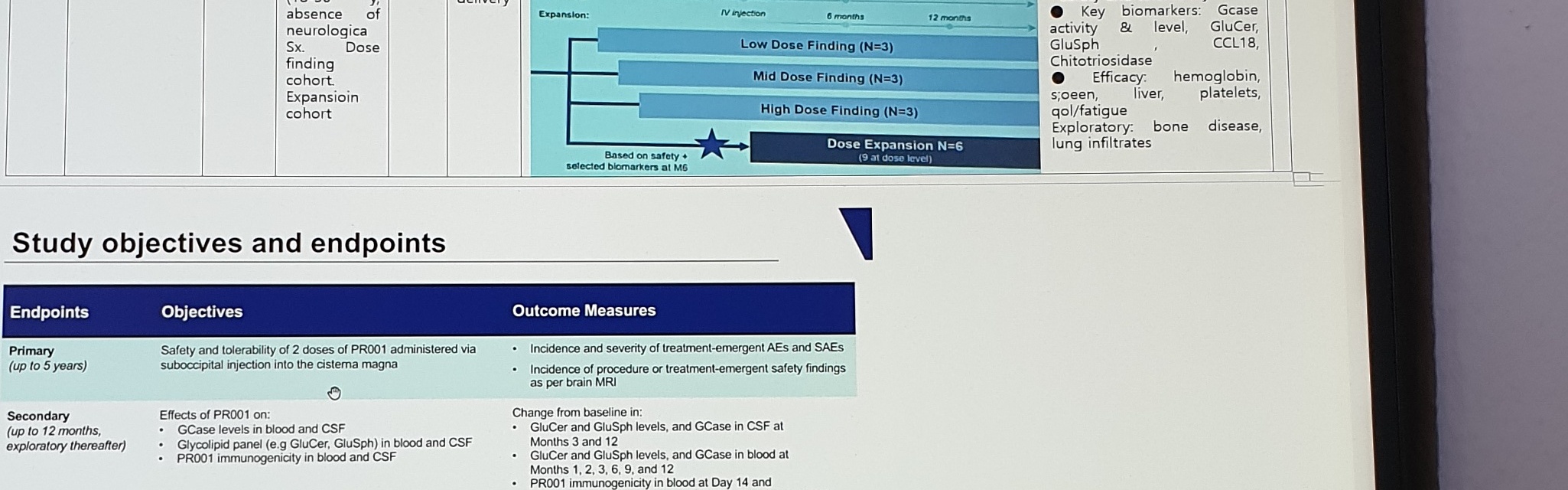
P1/2; PROCEED
target patient
GD I
n / eligibility
15 patients; (18-50 y, absence of neurological Sx. Dose finding cohort. Expansion cohort)
Safety and tolerability of 2 doses of PR001 administered via suboccipital injection into the cisterna magna
Incidence and severity of treatment-emergent AEs and SAEs; Incidence of procedure or treatment-emergent safety findings as per brain MRI
Secondary (up to 12 months, exploratory thereafter)
Effects of PR001 on: GCase levels in blood and CSF; Glycolipid panel (e.g., GluCer, GluSph) in blood and CSF; PR001 immunogenicity in blood and CSF
Change from baseline in: GluCer and GluSph levels, and GCase in CSF at Months 3 and 12; GluCer and GluSph levels, and GCase in blood at Months 1, 2, 3, 6, 9, and 12; PR001 immunogenicity in blood at Day 14 and Months 1, 3, 6, 9, and 12; and in CSF at Months 3 and 12
Exploratory (up to 12 months)
Effects of PR001 on: Measures of clinical and daily function and quality of life; Selected biomarkers of neurodegeneration in CSF; Imaging patterns based on MRI and dopamine transporter single photon emission computed tomography (DaT-SPECT)
Change from baseline in: CSF biomarkers of neurodegeneration at Months 3 and 12; Clinical scales, LED; DaT-SPECT at Month 12; DTI and ASL MRI at Months 6 and 12; Parameters captured by digital biomarker battery
GBA-PD Clinical Trial Comparison Table
field
PR001A (NCT04127578)
Ambroxol NCT02914366
Ambroxol NCT02941822
Venglustat NCT02906020
LTI-291 (NL7061)
sponsor
Prevail
Lawson Health Research Institute
UCL
Sanofi
Lysosomal Tx.
phase
1/2a
2
2a
2
2a
stage
Moderate to severe (H&Y 3-4)
Mild to moderate (H&Y 2-3.5)
Mild to moderate (H&Y 1-3)
Mild (H&Y 1-2)
Mild, mod, severe (H&Y 1-4)
duration
A single dose
52w
6 month
Part 1: 36w; Part 2: 52w
28 d
participants
16
75
20
243
40
mutation
GBA heterozygotes and homozygotes
No genotyping
10 GBA-positive & 10 GBA-negative
GBA heterozygotes
GBA heterozygotes and homozygotes (?)
required comorbidity
(Mild to mod) Dementia
NA
RBD
NA
Miglustat Clinical Trial Row
row
name / treatment
target pt
status
n
design
Tx
primary outcome measure
secondary
1
2
Add on to ERT
GD3, age restriction 없었기에 결과적으로 평균나이 10세에 함
30
OL, randomised
24m
Vertical saccadic eye movements (VSEM)
HSEM 도 No difference vs ERT alone; ↓ Chitotriosidase activity
(Schiffmann, 2008 #866) At Center 1, only patients 4 years or older were eligible, whereas at Center 2, there was no age restriction.During the initial 12 m, patients were randomized 2:1 to receive miglustat or "nomiglustat treatment." The randomized phase was followed by an optional 12-m extension phase in which all patients received miglustat. All patients received ERT during the 24-month period.No significant between-group differences in vertical saccadic eye movement velocity or in other neurological or neuropsychological evaluations were observed.(js: we don't know if this is due to lack of target engagement or lack of effect despite ↓ GlcSph in CNS, because no CNS endpoint was reported)
S-181 Preclinical Evidence
context
transcription
In vitro
(Burbulla et al. 2019, PMID) S-181 increased wild-type GCase activity in iPSC-derived dopaminergic neurons from sporadic PD patients, as well as patients carrying the 84GG mutation in GBA1, or mutations in LRRK2, DJ-1, or PARKIN who had decreased GCase activity.
In vivo
S-181 treatment of mice heterozygous for the D409V GBA1 mutation (Gba1D409V/+) resulted in activation of WT GCase and consequent reduction of GCase lipid substrates and α-syn in mouse brain tissue.
mice
GBA activity
GlcCer
GlcSph
a-syn (insoluble)
GbaD409V/+
아마 whole brain
Dose
Tx effect S-181
↑ (15%)
↓ (10%)
↓ (60%)
↓ (50%)
message
GlcSph는 downstream 이니까 change 증폭, & a-syn 도 GlcSph 따라감?
NCGC607 Start
NCGC607 (GBA activator)
Uncertain Spans
location
text/status
reason
LTI-291 mutation row
GBA heterozygotes and homozygotes (?)
The (?) is visible in the source table and should remain as a source uncertainty.
S-181 citation
(Burbulla et al. 2019, PMID)
PMID number is not visible on this photo.
bottom NCGC607 section
heading only
The content begins on the next photo; no body text is visible here.